
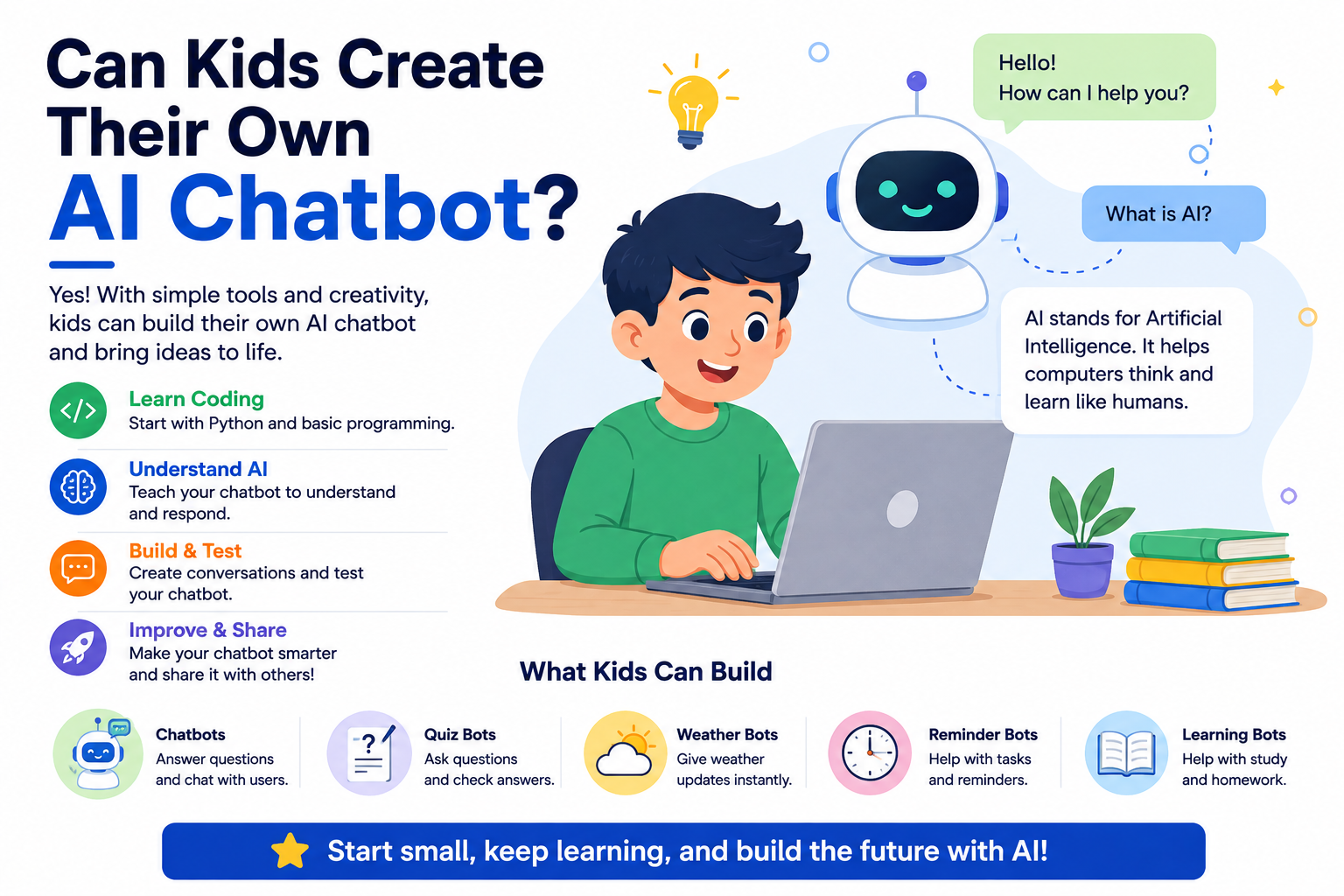
Can Kids Create Their Own AI Chatbot? A Beginner's Guide
Artificial Intelligence is changing the way we communicate, learn, and work. One of the most exciting applications of AI is the chatbot. Chatbots can answer questions, provide information, and even hold conversations with users.
The exciting news is that kids can also create their own AI chatbots. With beginner-friendly programming tools and a little creativity, students can learn how chatbots work and build their own simple AI-powered assistants.
What is an AI Chatbot?
An AI chatbot is a computer program that interacts with users by understanding questions and providing responses.
You may have already used chatbots on:
- Educational websites
- Shopping websites
- Banking apps
- Customer support pages
- Virtual assistants
Chatbots make communication faster and more interactive.
Can Beginners Build a Chatbot?
Absolutely!
Students do not need to be expert programmers to create their first chatbot.
By learning basic programming concepts and understanding how chatbots respond to user input, beginners can create simple conversational applications.
Many beginner-friendly platforms make chatbot development easy and enjoyable.
Skills Needed to Build an AI Chatbot
Students can begin by learning:
- Python Programming
- Variables
- Conditions
- Functions
- Lists
- Loops
- User Input
- Basic AI Concepts
These programming skills provide the foundation for chatbot development.
Tools Kids Can Use
Some beginner-friendly tools include:
- Python
- Scratch
- MIT App Inventor
- Google Teachable Machine
- Dialogflow (Beginner Level)
These platforms allow students to experiment with Artificial Intelligence while building confidence.
Simple AI Chatbot Projects
Students can build fun chatbot projects such as:
Greeting Chatbot
Responds to greetings and simple questions.
Quiz Chatbot
Asks questions and checks answers.
Homework Helper
Provides subject-related information.
Weather Chatbot
Displays weather information using APIs.
Personal Assistant
Answers questions about time, date, reminders, and simple tasks.
These projects make AI learning practical and engaging.
Benefits of Building Chatbots
Creating chatbots helps students develop:
- Logical thinking
- Problem-solving skills
- Creativity
- Communication skills
- Programming knowledge
- AI understanding
- Confidence in technology
Students also learn how AI is used in real-world applications.
Why Python is Great for Chatbots
Python is one of the easiest programming languages for beginners and is widely used in AI development.
It offers many libraries that simplify chatbot creation and introduce students to modern AI concepts.
Learning Python also prepares students for advanced topics like Machine Learning and Data Science.
Future Career Opportunities
Learning chatbot development can lead to careers such as:
- AI Engineer
- Software Developer
- Machine Learning Engineer
- Data Scientist
- Automation Engineer
- Python Developer
- NLP Engineer
- AI Researcher
These careers are expected to grow as AI adoption increases worldwide.
Tips for Students
If you're starting your AI journey:
- Learn Python basics first.
- Build small chatbot projects.
- Practice regularly.
- Explore AI tools.
- Keep improving your chatbot by adding new features.
Every successful AI developer starts with a simple project.
Conclusion
Creating an AI chatbot is an exciting way for students to explore Artificial Intelligence and programming. By learning Python and building simple conversational applications, kids can develop creativity, logical thinking, and valuable technical skills.
With curiosity, practice, and the right guidance, any beginner can take the first step toward building intelligent applications and becoming part of the future of AI.