
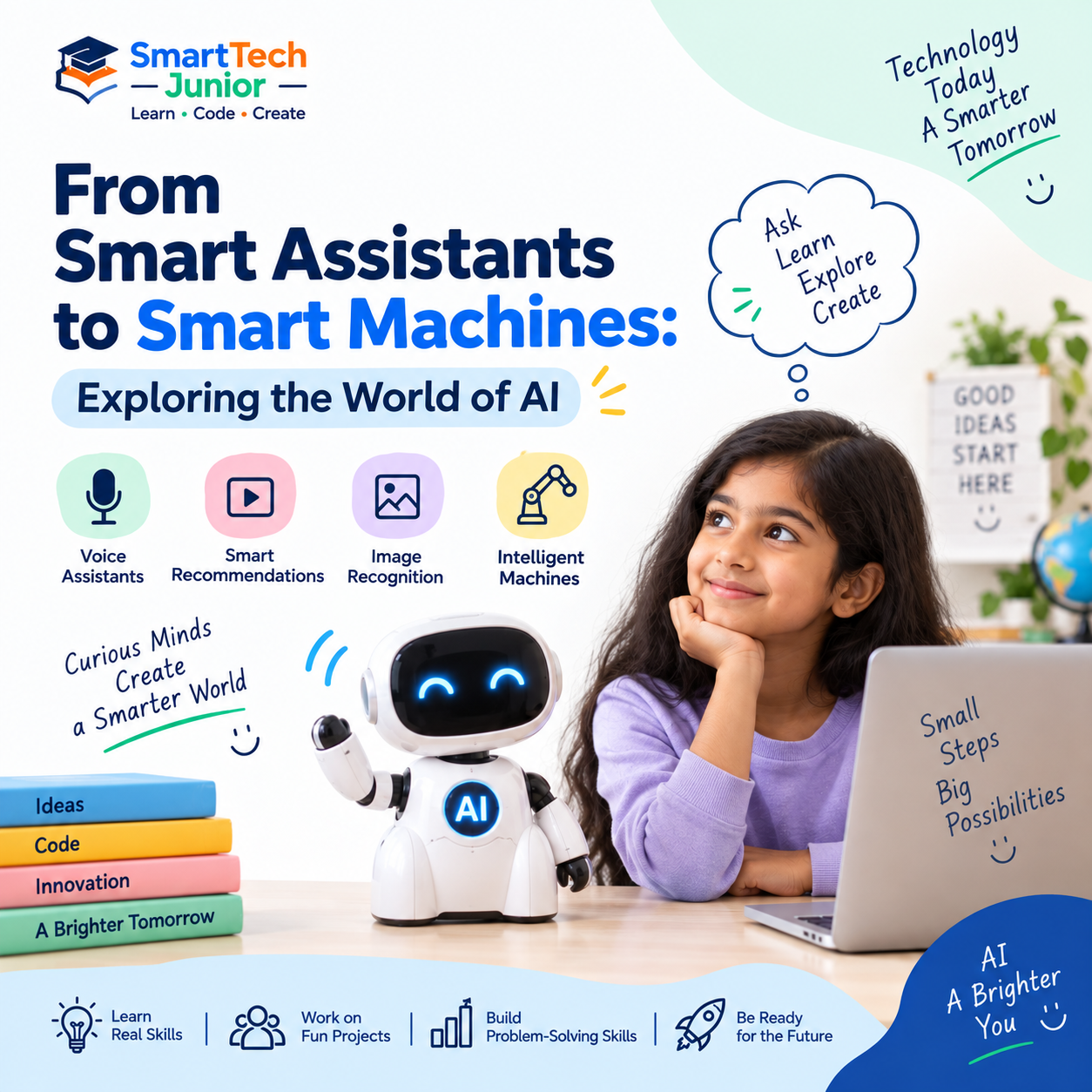
From Smart Assistants to Smart Machines: Exploring the World of AI
Artificial Intelligence is no longer something that exists only in science-fiction movies. It is already part of many technologies children interact with every day.
When a voice assistant answers a question, a streaming platform recommends a video, or a phone recognizes a face, AI may be working behind the scenes.
For young learners, exploring AI provides an opportunity to understand how machines can process information, recognize patterns, and make intelligent decisions.
What Is Artificial Intelligence?
Artificial Intelligence refers to technologies that enable computers and machines to perform tasks that typically require human-like intelligence.
These tasks can include:
- Understanding language
- Recognizing images
- Finding patterns
- Making predictions
- Recommending content
- Responding to questions
- Making decisions based on information
AI doesn't mean that a machine thinks exactly like a human. Instead, AI systems are designed to perform specific tasks using data, algorithms, and computational models.
AI Is Already Around Us
Children may encounter AI more often than they realize.
Examples include:
Voice Assistants
Voice assistants can recognize spoken commands and respond to questions or requests.
Recommendation Systems
Streaming platforms and online services can suggest content based on a user's previous activity.
Image Recognition
AI can analyze images and identify objects, faces, or other patterns.
Smart Search
Search engines use sophisticated systems to understand queries and provide relevant results.
Smart Devices
Some modern devices use AI to automate tasks and respond to user behavior.
Understanding these examples can help children see that AI is not just a futuristic concept—it is already part of the digital world.
How Do Machines Learn?
One of the fascinating areas of AI is Machine Learning.
Instead of manually programming every possible situation, machine learning systems can learn patterns from data.
For example, imagine showing a computer many pictures of different types of objects.
By analyzing patterns in the data, a machine-learning model can learn to recognize similar objects when it encounters new images.
The basic idea can be simplified as:
Data → Learning Patterns → Model → Prediction
This introduces children to a completely different way of thinking about programming.
AI and Coding Work Together
AI does not replace programming.
Programming provides the instructions, tools, and systems needed to build and use AI applications.
Python, for example, is widely used in AI and machine learning.
Young learners who first develop programming fundamentals can later explore how code can be used to work with data and intelligent systems.
This creates a natural learning pathway:
Coding → Programming Projects → Data → AI → Machine Learning
From Smart Assistants to Smart Machines
AI can be found in both software and physical systems.
A smart assistant is primarily a software-based application that processes information and responds to users.
A smart machine can combine AI with hardware, sensors, and mechanical components.
For example, an intelligent robot could use sensors to collect information about its surroundings and software to determine how it should respond.
This is where AI, programming, electronics, and robotics can come together.
Can Children Learn AI?
Yes, but the learning approach should be appropriate for their age and experience.
Young students don't need to begin with complicated mathematical models or advanced algorithms.
They can start with simple concepts such as:
- What is AI?
- What is data?
- How do computers recognize patterns?
- What is Machine Learning?
- How do recommendation systems work?
- How can AI solve problems?
As their programming skills grow, they can gradually move toward practical AI projects.
Learning AI Through Projects
Projects can make abstract AI concepts easier to understand.
Depending on their level, students can explore projects involving:
- Simple chatbots
- Image classification
- Voice-based applications
- Recommendation concepts
- AI-powered games
- Basic prediction systems
Projects give students an opportunity to see how AI concepts can be applied to real problems.
AI Encourages Curiosity
AI can lead children to ask fascinating questions:
How does a computer recognize a face?
How does a chatbot understand a question?
How does a recommendation system choose what to show me?
Can a machine learn from its mistakes?
These questions encourage children to explore technology beyond simply using applications.
AI and Problem-Solving
AI education can also develop problem-solving skills.
Students need to think about what problem they are trying to solve, what information is needed, and how a computer could process that information.
This encourages structured thinking and helps students understand that technology is a tool for solving real-world problems.
Understanding Responsible AI
Learning AI should also include an understanding of responsible technology use.
Children can gradually learn that AI systems can make mistakes and that the information used to train systems can affect their results.
Topics such as privacy, fairness, accuracy, and responsible use of technology can help students develop a balanced understanding of AI.
Learning AI at SmartTech Junior
At SmartTech Junior, students can explore Artificial Intelligence through age-appropriate technology learning and practical activities.
AI can be introduced alongside programming concepts, allowing learners to understand not only how to use intelligent tools but also how technology behind them works.
Through hands-on projects, students can experiment with AI concepts and develop the confidence to explore emerging technologies.
Where Can AI Learning Lead?
AI is connected to many rapidly developing fields, including:
- Machine Learning
- Robotics
- Computer Vision
- Natural Language Processing
- Data Science
- Automation
- Software Development
Early exposure allows children to discover these possibilities without requiring them to choose a particular career path at a young age.
Conclusion
From smart assistants to intelligent robots, Artificial Intelligence is changing the way people interact with technology.
For young learners, understanding AI can be an exciting journey into how computers process information, recognize patterns, and make predictions.
When combined with coding and hands-on projects, AI education can help children become not only users of intelligent technology, but curious creators who understand what happens behind it.