
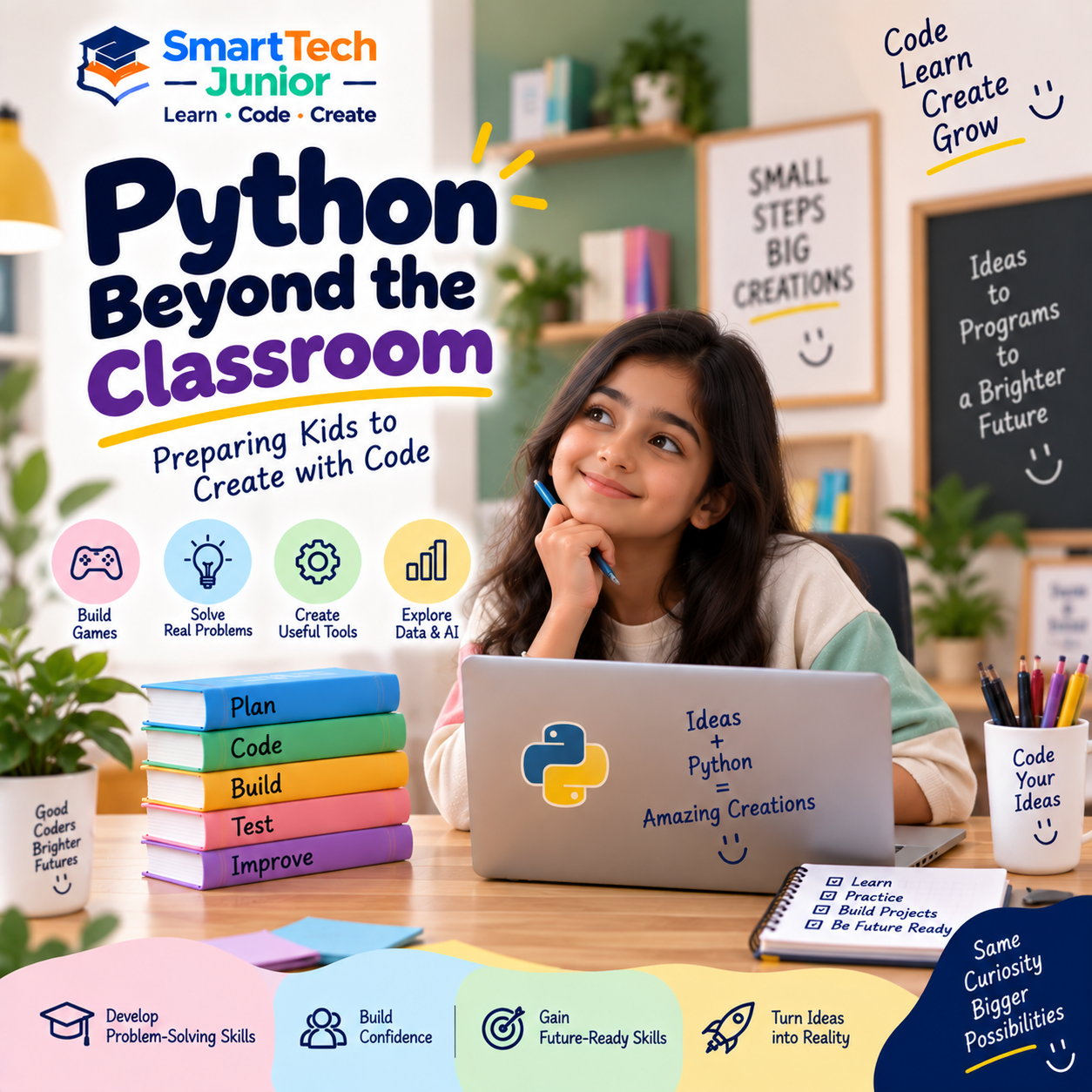
Python Beyond the Classroom
Learning programming becomes more meaningful when children can use it to create something of their own.
Python provides a simple and powerful starting point for young learners to explore programming, solve problems, and build practical projects.
Instead of limiting coding to classroom exercises, students can discover how Python can be used to turn their ideas into working programs.
From Learning to Creating
A programming lesson might introduce variables, conditions, loops, or functions.
But the real excitement begins when students combine these concepts to create something.
They could build:
- Quiz programs
- Calculators
- Mini games
- Student tools
- Simple automation projects
- Data-based applications
- Beginner AI projects
Each project gives students a reason to apply what they have learned.
Python Encourages Problem-Solving
Programming isn't simply about remembering commands.
Students need to understand a problem, break it into smaller steps, and decide how a computer can solve it.
For example:
Problem → Plan → Code → Test → Improve
This process encourages logical thinking and helps students become better problem solvers.
Learning Through Projects
Projects give children the opportunity to experiment.
A student may start with a simple calculator and later add more features.
A basic quiz can become an interactive learning application.
A small game can grow into a more complex project.
This gradual process helps students build confidence as their programming abilities develop.
Python Opens the Door to More Technology
Python is also useful because it can introduce students to different areas of technology.
As they progress, they can explore:
- Automation
- Data Science
- Artificial Intelligence
- Machine Learning
- Web Development
- Software Development
This gives students the flexibility to discover which areas of technology interest them most.
Building Confidence Through Code
One of the most rewarding moments for a young programmer is seeing their own program work.
They write the instructions, run the program, find mistakes, fix them, and finally see the expected result.
That experience can turn “I don't know how to code” into “I can build this.”
Why Practical Learning Matters
Children learn differently when they are actively creating.
Instead of only reading about programming concepts, they can experiment with them and immediately see the results.
Practical projects can make programming more engaging while helping students understand how individual concepts work together.
Preparing Kids for the Future
Technology continues to influence education, business, science, and everyday life.
Learning programming at an early age does not mean every child needs to become a software developer.
It gives them an opportunity to develop skills such as:
- Logical thinking
- Creativity
- Problem-solving
- Persistence
- Digital confidence
These skills can be useful regardless of the career path they eventually choose.
Learning Python at SmartTech Junior
At SmartTech Junior, students can explore Python through structured learning and practical projects.
Rather than focusing only on programming theory, students can gradually apply their knowledge to create their own programs and solve meaningful problems.
With guidance and hands-on practice, learners can move from writing their first lines of Python to developing projects they can proudly call their own.
Conclusion
Python can be more than another programming language to learn.
For young learners, it can become a tool for experimentation, creativity, and problem-solving.
When children move beyond simply completing exercises and start creating their own projects, programming becomes a skill they can actively use.
Learn the concepts. Build the projects. Create with code.